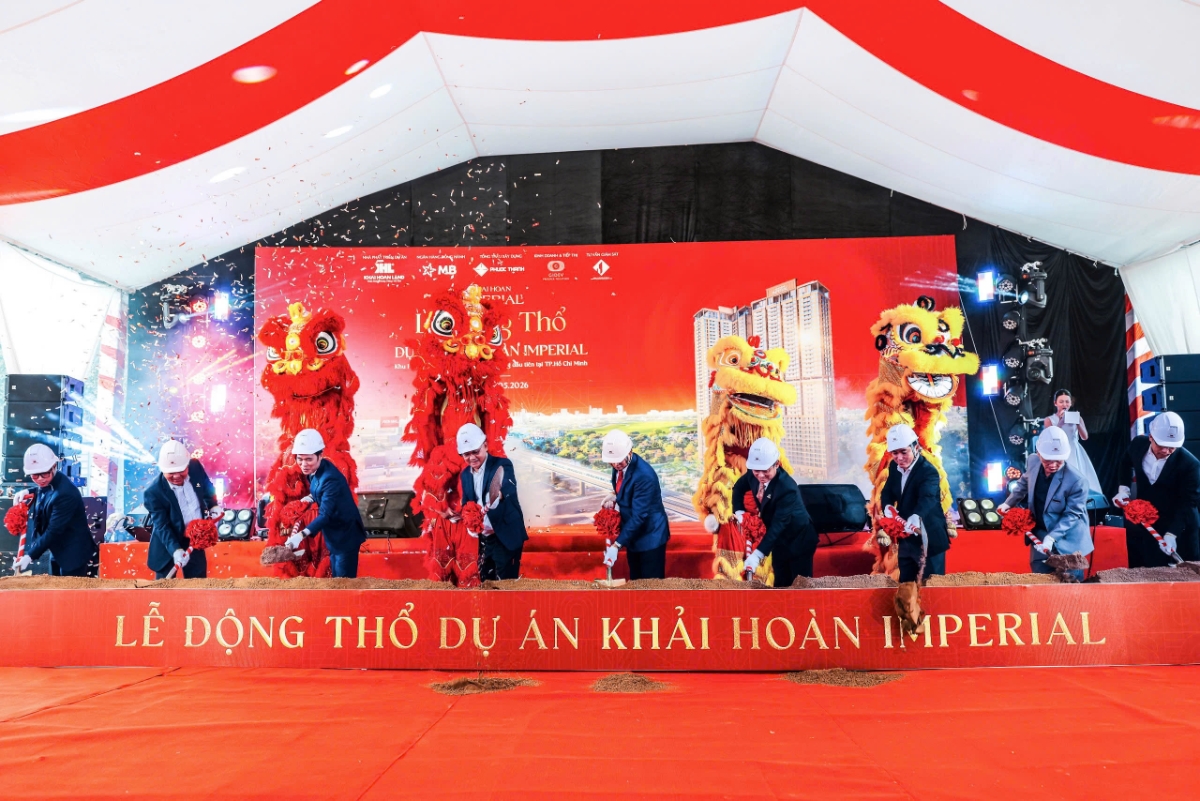
The real estate market has previously witnessed properties along Hanoi Highway—where Ho Chi Minh City’s Metro Line No. 1 (Ben Thanh – Suoi Tien) operates—experience multiple-fold price appreciation. Could the same scenario unfold along National Highway 13 (formerly Bình Dương), where Metro Line No. 2 (Thu Dau Mot – Ho Chi Minh City) is set to be developed, as newly launched projects are now being priced at up to USD 4,000 per square meter?

Illustrative Image
Apartment Prices in the Former Bình Dương Area Are Approaching Those of Ho Chi Minh City’s Former Urban Core
Recently, the real estate market in the newly expanded Ho Chi Minh City has attracted considerable attention following the launch of Khải Hoàn Imperial by Khải Hoàn Land, with pricing reportedly reaching as high as USD 4,000 per square meter—comparable to current apartment prices along the Ben Thanh – Suoi Tien Metro Line. This has sparked lively discussions among investors over whether a new pricing benchmark is emerging in the city’s real estate market.
According to preliminary information, the project introduces a distinctive concept as the market’s first Bespoke luxury apartment complex, positioning itself as a new residential benchmark within the expanded urban core of Ho Chi Minh City. Developed under a people-centric philosophy, every aspect of the project’s architecture and master planning has been thoughtfully tailored to reflect the lifestyles, preferences, and identities of discerning homeowners who value individuality and pursue a refined way of living. This unique positioning is widely regarded as one of the key reasons behind its headline-grabbing price point.

Bespoke Luxury Apartments Stir the Market with Pricing of USD 4,000 per Square Meter
In reality, several premium residential developments have already been launched along National Highway 13 in Northeast Ho Chi Minh City, with prices ranging from approximately USD 2,500 to USD 2,800 per square meter.
These include The Emerald Boulevard Bình Dương by Lê Phong, Landmark Bình Dương by Phú Cường Group, reportedly priced at VND 70–75 million per square meter; Green Skyline by TBS Group from VND 68 million per square meter; Urban Green at VND 75–85 million per square meter; and Habitat at VND 55–60 million per square meter. Further toward Bình Dương New City, Midori Park The Glory by Becamex Tokyu is priced between VND 58–60 million per square meter, while Sycamore by CapitaLand starts from approximately VND 60 million per square meter.
Market observations also indicate that land prices along National Highway 13 have recorded substantial growth in recent years. Five years ago, frontage land along the Hiệp Bình–Bình Triệu section traded at approximately VND 45–55 million per square meter. Today, prices have risen to VND 100–180 million per square meter. Meanwhile, properties located just 300–500 meters from the main road have also appreciated significantly, reaching VND 60–80 million per square meter—nearly doubling in value within the past three to four years.

Real Estate Values Rise Alongside Urban Infrastructure Development (Illustrative Image)
At a recent industry seminar, Mr. Võ Huỳnh Tuấn Kiệt, Director of Housing Services at CBRE Vietnam, stated that primary apartment prices in the former Ho Chi Minh City have increased by an average of 29% annually, while those in the former Bình Dương and Đồng Nai provinces have grown by approximately 14–15% per year. Notably, residential projects located along National Highway 13 have recorded price increases ranging from 15% to 25%, largely driven by the direct benefits of major transportation infrastructure investments. These values are expected to continue rising as National Highway 13 undergoes its planned expansion to a 60-meter-wide boulevard during 2026.
Just six months after the administrative merger, the apartment market in the former Bình Dương area is already experiencing an increasingly competitive pricing landscape. According to CBRE, approximately 60% of new apartment supply in the former Bình Dương market during 2026 falls within the premium and luxury segments—a market composition unprecedented in the area’s history.
Despite significant price appreciation, the eastern corridor of Ho Chi Minh City continues to attract substantial buyer interest. This indicates that the market is gradually embracing a new pricing benchmark in the former Thuận An and Dĩ An areas while adapting to their new status within the expanded Ho Chi Minh City. Many market observers believe that average residential property prices in the former Bình Dương area could approach the USD 4,000 per square meter threshold in the coming years.
Several Factors Are Driving Real Estate Prices Toward a New Benchmark
A combination of market and infrastructure fundamentals is expected to support the continued upward trajectory of real estate prices in the newly expanded Ho Chi Minh City, potentially establishing a new pricing benchmark in the near future.
When comparing key factors such as investment attraction, average income levels, and the seamlessness of transportation connectivity to District 1 (formerly Ho Chi Minh City), the former Dĩ An and Thuận An areas demonstrate notable advantages over the former District 9 and Thủ Đức. At the same time, residential property prices in these areas remain approximately 30–40% lower than those in the former District 9 and Thủ Đức, suggesting considerable room for future appreciation.
With the psychological barrier associated with a “Ho Chi Minh City address” effectively removed following the administrative merger, combined with more attractive pricing, greater housing supply, and continued infrastructure investment, homebuyers have increasingly shifted their attention toward residential projects in the former Bình Dương area.
This trend is clearly reflected in the growing number of buyers from the former District 12, Gò Vấp, Bình Thạnh, and Thủ Đức who have recently been searching for homes in Thuận Giao Ward, Bình Hòa Ward, and Bình Dương Ward. Demand for real estate in the former Bình Dương area has reportedly increased by 49% since the administrative merger.

Population Growth in the Former Bình Dương Area Continues to Rank Among the Highest (Source: Avison Young Research)
At the same time, a series of Transit-Oriented Development (TOD) urban zones are being planned along future metro corridors, creating a foundation for the integrated development of transportation infrastructure and urban space. This coordinated planning is expected to further enhance property values across the eastern region of Ho Chi Minh City.
In its in-depth report, “Transit-Oriented Development (TOD) in Ho Chi Minh City: The Future of Urban Development,” CBRE Vietnam identifies Transit-Oriented Development (TOD) as the “brain” of the new Ho Chi Minh City’s urban planning strategy. According to the report, real estate projects located within TOD influence zones typically command higher values than those in surrounding areas. The impact of transportation infrastructure on property values has consistently been demonstrated across global markets over several decades.
CBRE highlights examples from countries such as Singapore, Hong Kong, South Korea, and Thailand, where property values increased severalfold following the introduction of metro systems. In cities such as Bangkok and Manila, apartment prices along metro corridors rose by approximately 50% to 100% within the first five years after development, while large-scale urban projects situated along these transit lines experienced even more substantial appreciation.
Vietnam has witnessed similar pricing trends associated with metro development. One notable example is the Hanoi Highway corridor, where Metro Line No. 1 (Ben Thanh – Suoi Tien) operates. Apartment prices along this corridor—including developments in the former Thảo Điền, An Phú, and Thủ Đức areas—increased by approximately 50% to 200% during the period before and after the metro line became operational, reflecting patterns observed in many international markets.
Following a comparable development trajectory, National Highway 13 in Northeast Ho Chi Minh City—where the Thu Dau Mot–Ho Chi Minh City Metro Line has been prioritized for investment—is widely expected to experience similar real estate value appreciation in the coming years.
More recently, the accelerated expansion of National Highway 13 to a width of 60 meters, covering the section from Bình Triệu Bridge (formerly in Thủ Đức, Ho Chi Minh City) to Vĩnh Bình Bridge in Thuận An (now part of Ho Chi Minh City), has further strengthened market confidence, contributing to another wave of price growth along the corridor. Upon completion, the upgraded highway is expected to reduce travel time from the northeastern urban area to Hàng Xanh and the former District 1 city center to approximately 15 minutes.
In addition, Metro Line No. 2, which is planned to run along National Highway 13 from Thủ Dầu Một to Hiệp Bình Phước, follows a development model similar to Metro Line No. 1 (Bến Thành – Suối Tiên), which runs parallel to Hanoi Highway. The project is currently undergoing the preparation of its feasibility study and is widely regarded as a key catalyst for future property value appreciation along the corridor.
Industry experts predict that primary apartment prices along National Highway 13 will continue to rise significantly by 2027, following the completion of the highway’s expansion. This outlook is supported by the increase in official land compensation rates for frontage properties along National Highway 13 within Ho Chi Minh City, which were adjusted to more than VND 116 million per square meter under Decision No. 3137/QĐ-UBND dated June 23, 2025.
Meanwhile, under Decision No. 2934 approved by the Provincial People’s Committee in 2023, the highest land compensation rate for site clearance along the National Highway 13 expansion project—from Ông Bố Bridge to the Hữu Nghị Interchange in the former Thuận An City—reached more than VND 42 million per square meter.
These figures underscore the strong pricing fundamentals of real estate along the National Highway 13 corridor and suggest that property values per square meter are likely to remain at elevated levels in the years ahead.

Moreover, the new land price framework introduced in early 2026 increased official land prices in the former Binh Duong Province by as much as eight times. Combined with rising construction material costs and higher land acquisition expenses, these factors have inevitably been reflected in property prices, making significant price reductions increasingly unlikely.
As a result, market interest in Northeast Ho Chi Minh City has grown substantially in recent years, with many buyers seeking to capitalize on future growth opportunities at an early stage.
Another key advantage is the area’s strong demographic fundamentals. Northeast Ho Chi Minh City records one of the country’s highest migration rates, supported by a young workforce and a large concentration of professionals employed in industrial parks and high-tech manufacturing zones. According to 2024 statistics, the region posted the highest net migration rate nationwide at 95.6%. Consequently, the apartment market in Northeast Ho Chi Minh City continues to demonstrate stable and selective absorption. Industry observers believe that the tens of thousands of residential units currently entering the market could face supply shortages in the not-too-distant future as demand continues to strengthen.
Notably, although the Northeast Ho Chi Minh City market has seen an increase in apartment supply, there remains a shortage of truly high-end residential developments. Market observations indicate that while new condominium projects have entered the market in 2025, premium products featuring sophisticated design, upscale amenities, and a distinctive identity remain limited. These are precisely the types of residences sought after by experts, senior executives, and affluent buyers, who prioritize unique living environments, comprehensive internal facilities, high security standards, and professional property management.
This customer segment is willing to pay a premium for projects that deliver superior living quality, reflecting the continuous evolution of homebuyers’ expectations. As residential product standards continue to improve, the overall pricing benchmark for real estate in the new Ho Chi Minh City is expected to rise accordingly.
Recently, several premium residential developments have been introduced to the market. However, their number remains far below actual demand. As a result, these projects have attracted strong interest and positive market reception from homebuyers upon launch.